

Before You Buy
Three paths lead through this guide, in order:
- Start with what you own. Comfortable clothes you already have can carry you through your first outings. Nothing in this guide is required before a first run.
- Upgrade when a real need appears. Add a piece when you notice a specific problem: cold hands, soaked socks, a rub that chafes, a dark stretch you can't see.
- Build the complete system when your commitment justifies it. The full system below covers warm, cool, wet, windy, and low-light runs. It supports your decision; it does not make dangerous conditions safe.
Every product judgment in this guide carries one of two labels.
- Independently researched: rests on published guidance cited in the Sources list, or on manufacturer and retailer listings checked in October 2026.
- Specification-based: follows from stated specifications such as fabric content, waterproof rating, or lumen output.
Each category names typical picks at three budget tiers.
- Affordable: the lowest typical cost that still does the job.
- Mid-tier: the workhorse band most runners settle into.
- Premium: refined materials and features, not a better decision.
The picks are representative examples, not rankings and not test results: a typical product shows what the criteria look like in the real world, and any well-fitting equivalent does the same job. Men's and women's options appear wherever fits differ; unisex gear is marked as such.
Prices change, so none are shown here. Every pick links to Amazon product listings so you can check availability and buy; the links are checked and refreshed regularly.
One more rule for how to buy: buy what the current season needs now, and treat next season's list as a plan. Part of the purchase is emotional, and that is fine. Owning the system makes the decision real, so buy it in an order that respects the decision instead of rushing it.
Before any purchase, run three quick tests.
- The role test: name which layer role the piece fills, from the layering section below.
- The label test: check that this guide, or a cited source, tells you how the judgment was made.
- The season test: confirm the piece serves this season or the next, not some hypothetical one.
A purchase that passes all three is a gap closed, not a guess.
The Complete Gear System, Need by Need
The nine sections below are organized by the problem each piece solves, not by store aisle. Read the sections that match your conditions, then let the season plans near the end decide what to buy first.
Across all conditions, the minimum system is small:
- shoes that fit,
- season-weight socks,
- a base layer,
- one insulating layer,
- one shell,
- head and hand coverage,
- one reflective detail or light,
- sun basics,
- an anti-chafe balm, and
- somewhere to carry your keys.
Shoes and Socks
Fit is individual: a shoe that feels great on one runner can hurt another, so treat the models in the table below as examples to calibrate against, not as recommendations. The useful advice is how to choose, not which model to buy.
Choosing Shoes That Fit
Look for a shoe with room for your toes to spread, a heel that holds without slipping, and no pinch points when you walk around the store. Leave about a thumb's width between your longest toe and the front of the shoe, because your foot slides forward a little on every step.
Try shoes on later in the day, when your feet are at their largest, in the socks you'll run in. Buy somewhere with a return policy that covers a short indoor test run, and keep the first run indoors until you're sure.
Ignore marketing words and judge by feel. Support, cushion, and stability mean different things to different brands, and none of them matter if the shoe pinches.
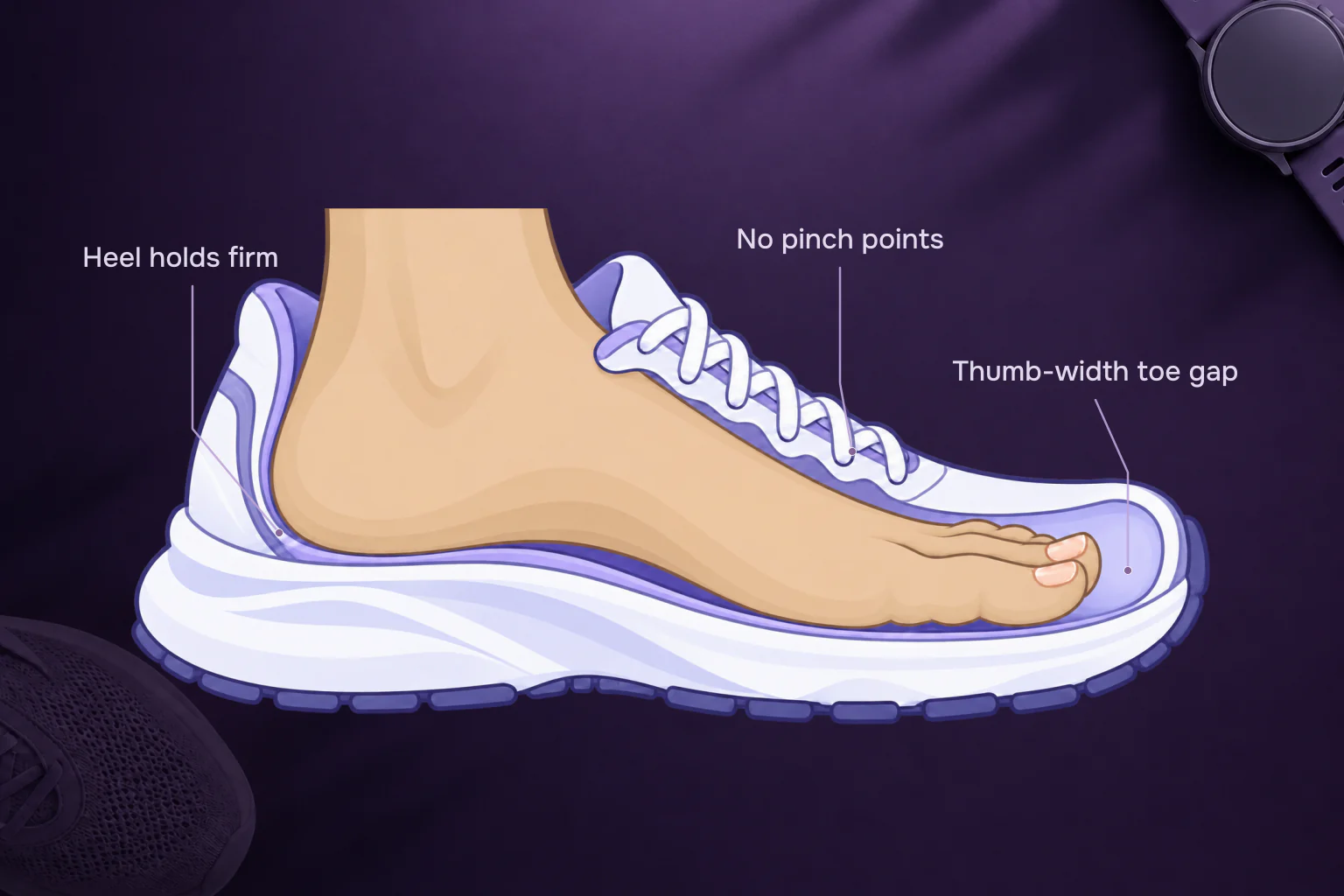
Ordering online is fine once you know your size and shape; the first pair of any model deserves a store try-on or a generous return policy. When the store lets you jog a few steps, take them: twenty steps in a shoe answers more than twenty minutes of reading about it.
Replace a pair when the tread is visibly worn or the cushioning feels dead rather than springy. A worn shoe still looks like a shoe; it just stops protecting you.
Road, Trail, and a Second Pair
If you run roads and sidewalks, a road shoe is right. Trail shoes only earn their place if you actually run trails: their lugs trade grip on dirt for comfort and weight on pavement.
A second pair is not a luxury once you run a few times a week. Rotating two pairs lets each one's cushioning rebound between runs and makes a worn-out pair obvious sooner. Buy the second pair after the first one proves itself, not before.
Typical picks at each tier, listing-checked in October 2026. Each model comes in men's and women's versions, and a well-fitting equivalent does the same job. Independently researched.
| Tier | Men's typical pick | Women's typical pick | What they are |
|---|---|---|---|
| Affordable | New Balance Fresh Foam 680 v9 | ASICS GEL-CONTEND 9 | Budget neutral daily trainers |
| Mid-tier | Brooks Ghost 17 | ASICS GEL-CUMULUS 27 | Workhorse neutral daily trainers |
| Premium | Brooks Glycerin 23 | ASICS GEL-NIMBUS 28 | Max-cushioned neutral trainers |
Socks
Socks do more work than they get credit for. Choose quick-drying, non-cotton socks in synthetic or wool, so soaked socks don't chafe into blisters.[1] Expect wet feet in the rain; quick-drying socks recover in minutes, while cotton ones stay soaked.
Merino socks share the wool tradeoff from the base-layer section: odor resistance and warm-when-damp against slower drying and a higher price.
Fit matters as much as fabric:
- no bunching at the heel,
- no thick toe seam pressing on your toes.
Match thickness to the season, thin for warm weather and heavier for cold, and treat socks as a real purchase rather than an afterthought, because they sit between your foot and your most important piece of gear.
Typical picks at each tier, listing-checked in October 2026. Independently researched.
| Tier | Typical pick | What it is |
|---|---|---|
| Affordable | Under Armour ArmourDry Run Cushion 3-Pack | Light-cushion no-show multipack |
| Mid-tier | Feetures Elite Light Cushion; Balega Hidden Comfort | Technical single-pair socks with targeted compression and seamless toes |
| Premium | Darn Tough Vermont; Smartwool Run Targeted Cushion | Merino-blend running socks |
| Sock weight | For | What to check |
|---|---|---|
| Thin | Warm and hot weather | Breathable weave, minimal cushion |
| Midweight | Cool weather, most of the year | A little cushion under the ball and heel |
| Heavy | Cold weather | Warmth without bunching in the toe box |
Length matters as much as thickness: a no-show can slip under the heel in a deep shoe, while a crew takes the rub of the shoe collar. These three sit at noticeably different heights.
| Sock length | Example | When it makes sense |
|---|---|---|
| No-show | Under Armour ArmourDry Cushion | Warm weather and low-cut shoes; check it stays anchored under the heel. |
| Crew | Under Armour ArmourDry Cushion Mid-Crew 3-Pack | The default for most running: covers the ankle and takes the collar rub. |
| Long | Smartwool Women's Targeted Cushion Compression | Cold weather and compression; check it does not bunch behind the knee. |
- Buy now: one pair of shoes that fits this season's surface, plus a few pairs of season-weight socks.
- Plan for next: a second pair of shoes to rotate once your runs are regular, and the opposite thickness in socks.
Next-to-Skin Layers
A base layer's first job is moving moisture away from your skin; warmth is its second job. It should fit close without squeezing, because the fabric can only wick what it touches.
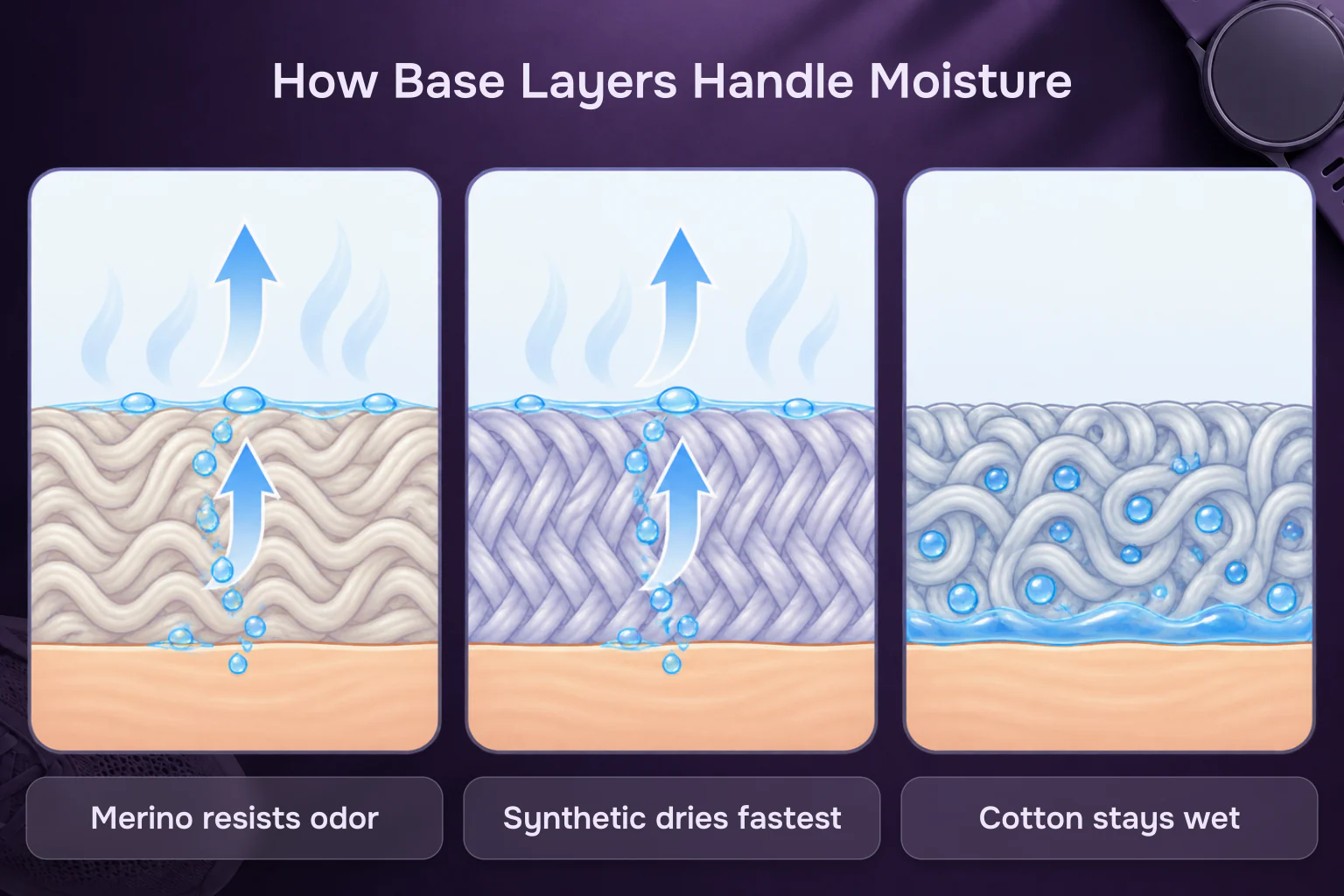
Two materials do the work, and the tradeoff is real. Merino wool resists odor, so it can go several runs between washes, and it keeps insulating even when damp, but it usually costs more and dries slower.
Synthetic fabrics dry fastest and take abuse, but they hold odor sooner. Both beat cotton, which stays heavy and cold once it's wet.[1] Weights run from lightweight for summer to midweight for winter, stated in grams per square meter; higher means warmer.
| Trait | Merino wool | Synthetic |
|---|---|---|
| Odor | Resists odor across several runs | Holds odor sooner |
| Drying | Dries slower | Dries fastest |
| When damp | Still insulates | Less warm when soaked |
| Price | Usually higher | Usually lower |
Typical picks, checked against manufacturer and retailer listings in October 2026. Independently researched.
| Tier | Men's typical pick | Women's typical pick | What they are |
|---|---|---|---|
| Affordable | Under Armour ColdGear Mock Neck Long Sleeve | Under Armour ColdGear Mock Neck Long Sleeve (women's version) | Synthetic cold-weather base layers |
| Mid-tier | Smartwool Classic All-Season Merino 150 Crew | Smartwool Classic All-Season Merino 150 (women's version) | Lightweight merino-blend base layers |
| Premium | Icebreaker Merino 200 Oasis Long Sleeve Crew | Icebreaker Merino 200 Oasis Long Sleeve Crew (women's version) | 200-weight merino base layers |
In warm weather, the affordable tier's typical pick is men's Under Armour HeatGear or women's Under Armour HeatGear; in cold, men's ColdGear or women's ColdGear. On the synthetic side, men's Patagonia Capilene Cool Daily or women's Patagonia Capilene Cool Daily is the mid-tier workhorse, and men's Capilene Midweight or women's Capilene Midweight the premium one.
For runners who wear a sports bra, the same wicking rule applies: choose one that holds during running without pinching or digging, and replace it when the band loses its grip. Fit matters more than brand, and support matters more than fashion.
Support levels map to conditions:
- a light, breathable bra suits easy hot-weather runs;
- medium support covers most everyday running;
- high support is the honest choice for larger cup sizes or faster days, where bounce is the problem a bra exists to solve.
In cool weather, the bra sits under your base layer, so pick a fabric that wicks rather than one that holds sweat against the skin. Support labels below come from the makers' own product names where they exist. Specification-based.
| Tier | Typical pick | Support | What it is |
|---|---|---|---|
| Affordable | Under Armour Crossback Mid Sports Bra | Medium | Everyday breathable bra |
| Affordable | Champion Spot Comfort Full-Support Sports Bra | High | Band-and-cup sizing on a budget |
| Mid-tier | Brooks Drive 3 Pocket Run Bra | High | Storage pockets for keys or a phone |
| Mid-tier | Smartwool Intraknit Racerback Bra | Light to medium | Merino blend for cool weather |
| Mid-tier | Icebreaker Cool-Lite Merino Anatomica Seamless Sport Bra | Light to medium | Merino blend, breathable for heat |
| Premium | SheFit Ultimate Sports Bra | High | Front zip with adjustable band and straps |
| Premium | Lululemon Run Times Bra High Support | High | Cup range B to G for larger busts |
| Premium | Brooks Dare Crossback Run Bra 2.0 | High | Premium crossback run bra |
- Buy now: one base layer for the current season, wool or synthetic.
- Plan for next: the opposite weight: a lighter one before summer, a heavier one before winter.
Insulation Layers
Insulation is the middle layer that holds the warmth your body makes. Fleece, mid-weight long sleeves, and vests all do this job; a vest is the venting option because it leaves the arms free.
Judge warmth against breathability, because running keeps producing heat while you wear it. Fleece weight in grams per square meter is the honest number: a light fleece adds a little warmth and breathes well, a heavy fleece adds real warmth for cold days.
A full or half zip gives you the venting you'll want once you warm up, and a pocket turns the layer into carrying capacity.
One distinction saves money: a puffy down or synthetic jacket is a walking-warm layer, not usually a running layer. Puffies hold heat extremely well at rest and get clammy fast at running effort. For running, a fleece or mid-weight knit does the same job while letting sweat move.
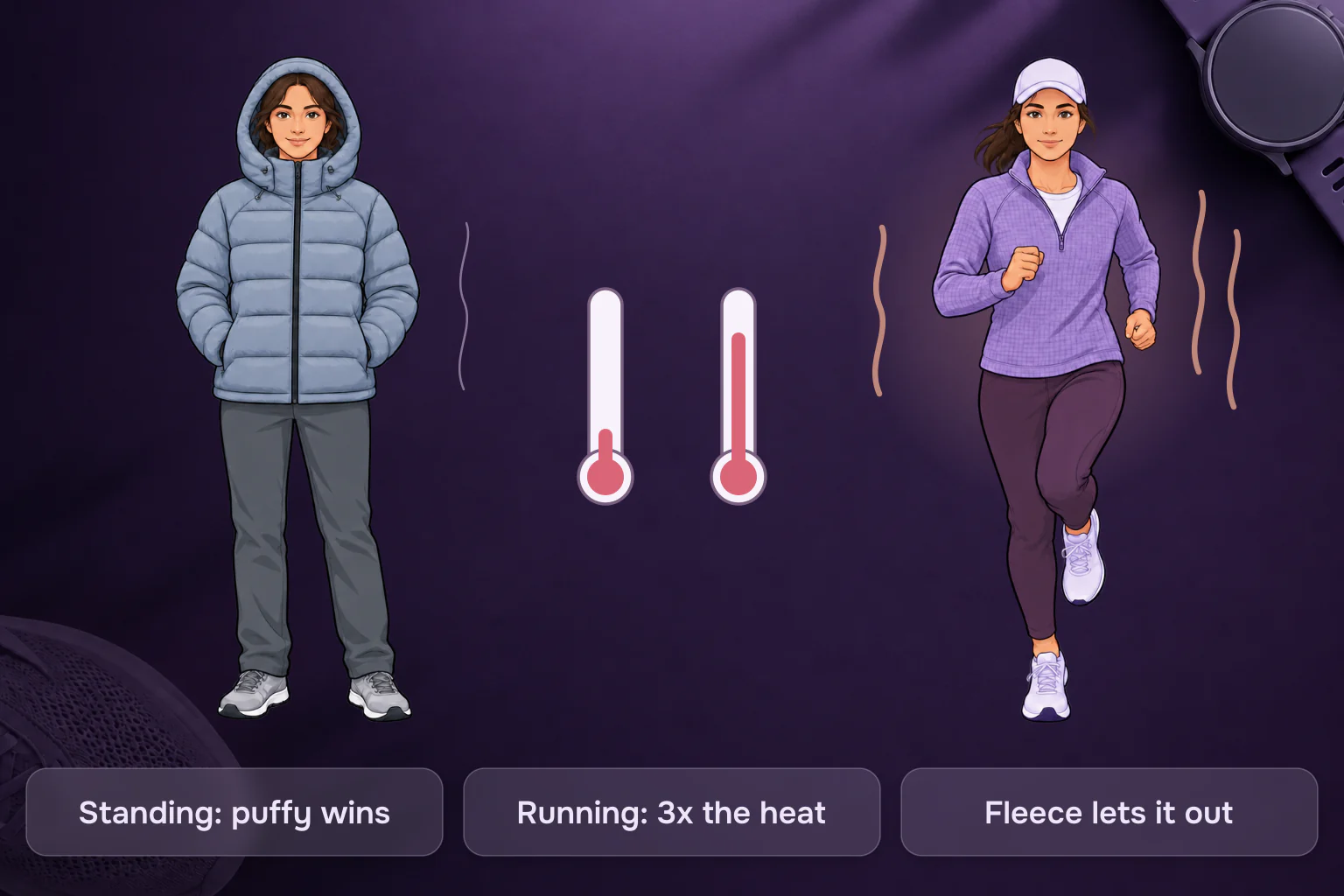
How much insulation you need follows how you dress for the cold, which our guide to running in the cold covers. Insulation only works if the base layer under it moves moisture first; a soaked base layer turns any mid layer clammy, so build from the skin outward.
| Option | Best at | Tradeoff |
|---|---|---|
| Light fleece | Cool mornings, layering under a shell | Not enough alone in real cold |
| Heavy fleece | Cold days at easy effort | Can feel warm once you get moving |
| Mid-weight knit | Everyday cool weather | Less wind protection than fleece |
| Vest | Cold starts with free arms | Arms stay uncovered |
Typical picks, checked against manufacturer and retailer listings in October 2026. Independently researched.
| Tier | Men's typical pick | Women's typical pick | What they are |
|---|---|---|---|
| Affordable | Under Armour Rival Fleece Hoodie | Under Armour Rival Fleece Full-Zip Hoodie | Midweight fleece hoodies |
| Mid-tier | Brooks Notch Thermal Hoodie 2.0 | baleaf Fleece Thermal Running Hoodie | Thermal running hoodies |
| Premium | Squak Classic Men's Microgrid Fleece Hoodie | Squak Classic Women's Microgrid Fleece Hoodie | Technical grid fleece hoodies |
Vests are rare below the premium tier; the typical pick there is the men's 33,000ft Lightweight Softshell Vest or women's 33,000ft Fleece-Lined Softshell Vest.
- Buy now: one insulating layer for the season's coldest ordinary runs.
- Plan for next: a heavier mid layer before deep winter, or a lighter one before spring.
Wind and Rain Layers
Wind and rain need different shells, and buying one expecting it to do both is the classic mistake.
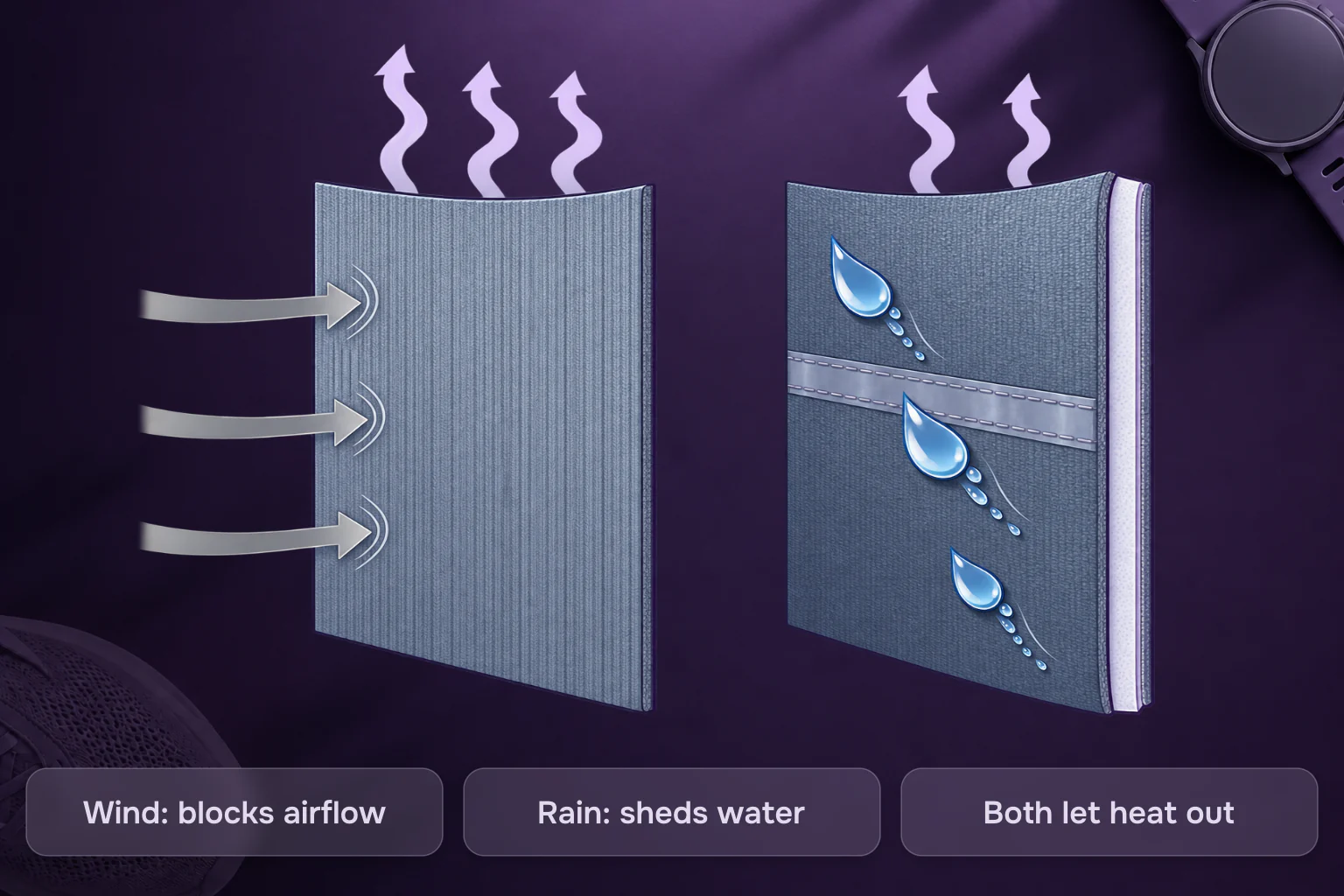
A wind shell is light, breathable, and does the most work in ordinary wind: it blocks the airflow that makes the same temperature feel colder.[2] A rain shell is waterproof, which makes it inevitably less breathable. No rain jacket keeps hard rain out and sweat moving freely at the same time; waterproof layers trade one for the other.[3]
For a rain shell, look for a waterproof rating measured in millimeters, where higher means more waterproof; ratings commonly run from about 5,000 mm, enough for light rain, to 20,000 mm or more for sustained downpours.
The rating is only half the story: taped or sealed seams matter because water finds the stitching first. Add vents such as pit zips, a hood that stays up while you run, and a fabric that packs small enough to carry. Plan to refresh the water-repellent treatment when water stops beading on the surface.
For a wind shell, weight and breathability beat waterproof ratings: the job is stopping airflow, not rain. Many wind shells shrug off a light drizzle, which covers a lot of ordinary weather. The two shells side by side:
- Wind shell: light, breathable, packs small. Blocks airflow and shrugs off a light drizzle.
- Rain shell: waterproof with taped seams and vents. Less breathable and warmer inside, and the right choice for real rain.
| Rating | Covers |
|---|---|
| About 5,000 to 10,000 mm | Light to steady rain |
| About 10,000 to 20,000 mm | Steady to heavy rain |
| 20,000 mm and up | Sustained downpours |
Typical picks, checked against manufacturer and retailer listings in October 2026. The waterproof label appears only where the maker's own product title says so. Independently researched.
| Tier | Men's typical pick | Women's typical pick | What they are |
|---|---|---|---|
| Affordable | Under Armour Freedom Windbreaker | Under Armour Rival Sport Windbreaker | Lightweight windbreakers |
| Mid-tier | Janji Zephyrunner Wind Shell | Janji Zephyrunner Wind Shell (women's version) | Packable wind shells |
| Premium | Salomon Bonatti Cross Wind | Patagonia Houdini Jacket (women's version) | Ultralight windbreakers |
| Tier | Men's typical pick | Women's typical pick | What they are |
|---|---|---|---|
| Affordable | ASICS Road Packable Jacket | ASICS Road Packable Jacket | Packable, lightweight running jackets; check the waterproof rating |
| Mid-tier | Brooks Canopy Jacket | Brooks Canopy Jacket (women's version) | Waterproof, packable running jackets |
| Premium | Salomon Bonatti Waterproof Jacket | Salomon Bonatti Waterproof Jacket (women's version) | Waterproof, packable running jackets |
Which shell you need for a given run is a weather decision: see running in the rain for the temperature rule and running in the wind for wind layers.
If you run mostly in dry cold, buy the wind shell first; if you run through real rain, the rain shell comes first.
- Buy now: the shell your current season asks for.
- Plan for next: the other one: a rain shell before a wet season, a wind shell before a breezy one.
Head and Hand Coverage
Head and hands are where you adjust comfort fastest, because they sit at the edges of the body and lose or gain warmth quickly. That makes these the most useful small purchases in the whole system, and the easiest to carry when you take them off.
For the head: an ear warmer headband covers the ears without overheating the rest of the head; a beanie adds warmth for cold runs; a brimmed cap shades sun and keeps rain off your eyes.
For hands: lightweight gloves for cool starts, fleece gloves for cold, and mittens when your fingers run cold together, because mittens let fingers share warmth instead of each warming its own sleeve.
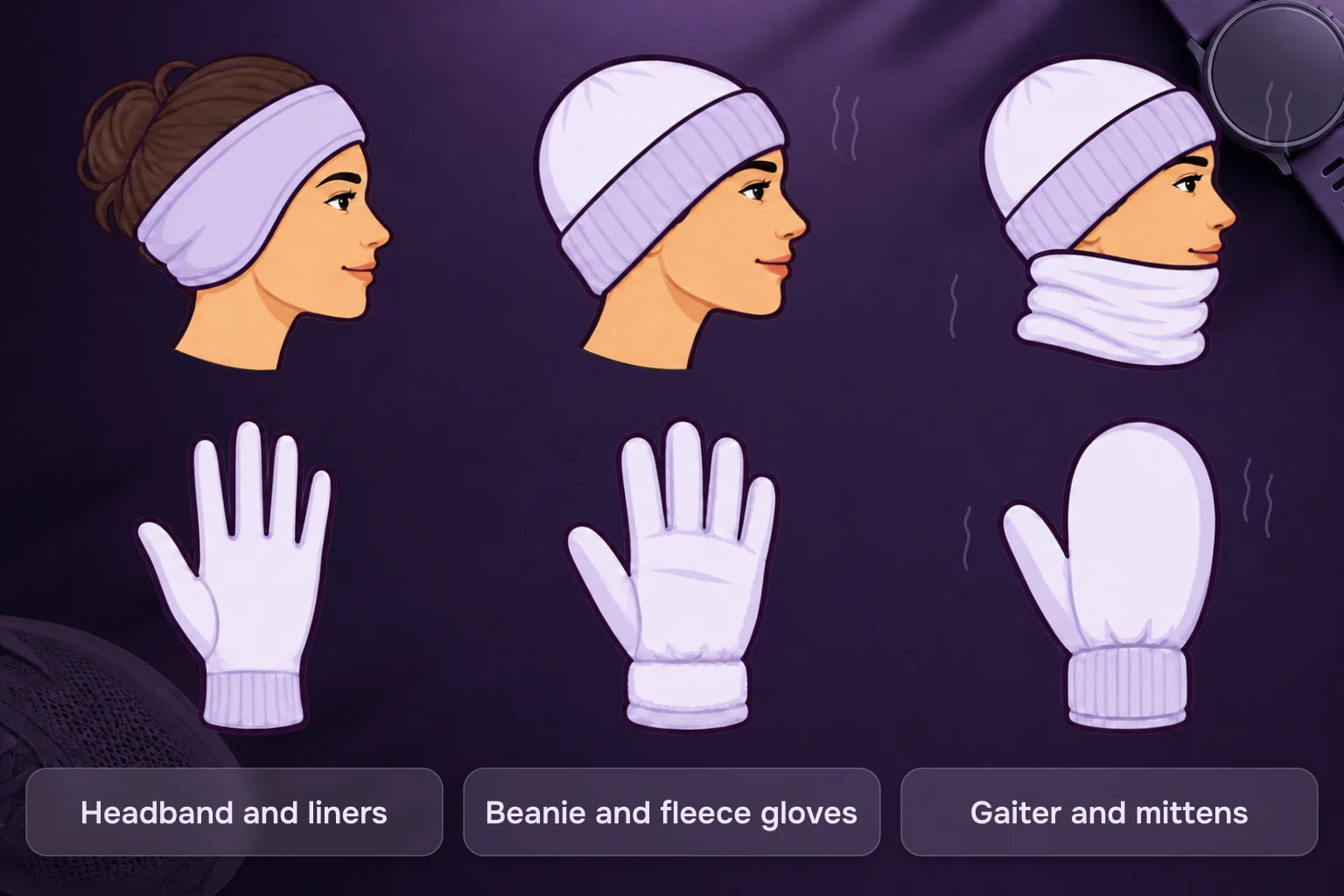
A neck gaiter closes the gap at the collar and pulls up over the chin in wind. Face protection belongs only in deep, windy cold, not in an ordinary cold outfit.
These are exactly the pieces you'll take off first as you warm up; see running in the cold for the adjustment order. Pick pieces small enough for a pocket, because they'll spend part of every run there.
| Conditions | Head | Hands |
|---|---|---|
| Cool mornings | Ear warmer headband | Lightweight gloves |
| Cold | Beanie | Fleece gloves |
| Deep cold or cold hands | Beanie plus gaiter over the chin | Mittens |
| Sun or rain | Brimmed cap | Nothing extra |
Typical picks at each tier, checked against manufacturer and retailer listings in October 2026. Independently researched.
| Tier | Head typical pick | Hands typical pick | What they are |
|---|---|---|---|
| Affordable | TrailHeads Tempo Running Headband | Under Armour Storm Run Liner Gloves in men's or women's version | Ear-warming headband and lightweight liner gloves |
| Mid-tier | Smartwool Intraknit Merino Tech Headband | Smartwool Active Fleece Glove | Merino-blend headband and fleece glove, unisex |
| Premium | Smartwool Merino Sport 250 Beanie | Brooks Fusion Midweight Glove 2.0 | Lightweight running beanie and midweight cold-weather glove, unisex |
For the neck, the affordable pick is the TrailHeads Multiband and the mid-tier classic is the Buff Original EcoStretch Neckwear; both are unisex. When gloves aren't enough, mittens beat them at any tier.
- Buy now: one head piece and one hand piece for the current season.
- Plan for next: the colder or warmer end of the range as the season turns.
Visibility and Lighting
Visibility is a year-round need that peaks when the days are short. The goal is two-way: drivers and other people see you, and you see the path.
For being seen, reflective material on moving parts, ankles and wrists, works better than a single logo on the chest, because motion is what catches the eye. Dawn and dusk are the trickiest light: bright enough to feel safe, dark enough to hide you.
For seeing, follow the road convention: a white light facing forward, a red light facing back, and a headlamp when you need to watch your footing.
For a headlamp, compare three numbers.
- Lumens: more means more light.
- Modes: a low mode saves battery.
- IPX rating: match it to the rain you run in.
Rechargeable lights cost more up front and save batteries over a season, and they charge like a phone, so build the habit of plugging them in after the run. A clip-on light on a cap or belt is the smallest possible start.
A reflective vest should sit flat over your outermost layer and reflect all the way around, so you stay visible when you turn sideways.
If you can choose when to run, our guide to the best time to run today helps you compare brighter and darker windows.
| When you run | Add |
|---|---|
| Daylight | One bright color or reflective detail |
| Dawn or dusk | Reflective vest, white front light, red rear light |
| Dark streets | The above plus a headlamp |
| Dark trails | Headlamp with enough lumens to read the ground |
Typical picks at each tier, checked against manufacturer and retailer listings in October 2026. Independently researched.
| Tier | Reflective or light-up vest | Headlamp |
|---|---|---|
| Affordable | Amphipod Xinglet Reflective Vest | Nathan Neutron Fire RX Runner's Headlamp 2.0 |
| Mid-tier | Proviz REFLECT360 Running X Vest | Petzl Actik Core |
| Premium | Noxgear Tracer2 light-up vest | Black Diamond Storm 500-R |
For a clip-on rear light, the typical pick is the Cygolite Hypershot 350, sold as a bike light and widely used by runners. All of these are unisex.
- Buy now: at least one reflective detail or clip-on light if you run near dawn or dusk.
- Plan for next: a headlamp and a rear light when dark runs become regular.
Sun Protection
Sun is a four-season need: it is strongest in summer, and it reflects off snow in winter. The same three pieces cover every season, which is why this section is short.
A brimmed cap shades your eyes. Sunglasses spare you squinting on bright mornings, so pick a pair that stays put when you bounce and doesn't fog from your breath. Sunscreen covers the skin that's still exposed.
The sun sits low at dawn and dusk and finds your face even in cool weather, so the cap and sunscreen are not summer-only items. Choose sunscreen with SPF 30 or higher, broad-spectrum coverage, and water resistance, since you'll sweat.[4]
In heat, light, loose, light-colored clothing runs cooler than dark, tight layers. On a long sunny run, reapply to exposed skin before it burns.
Typical picks at each tier, checked against manufacturer and retailer listings in October 2026. All three columns are unisex. Independently researched.
- Buy now: the pieces for the current season's sun.
- Plan for next: nothing new, honestly. The same cap, glasses, and sunscreen work year-round.
Anti-Chafing
Chafing is mechanical: skin rubs against skin, or fabric rubs against skin, and moisture makes the friction worse. The fix is to remove the rub first, then protect what's left. It is a comfort problem with a gear solution, not a medical one.
Choose shorts or underwear long enough that skin doesn't rub skin, with flat or minimal seams and wicking fabric. Where straps, waistbands, or fabric still rub, apply an anti-chafe balm or petroleum jelly before the run.[5]
The usual spots:
- inner thighs,
- underarm seams,
- the band line of a sports bra, and
- waistbands.
Check new gear at those spots first, because they announce a problem on the first run. New gear is the most common culprit: a new waistband or vest strap needs a few runs, and if it still rubs after that, change the fit or add the balm.
Wet weather raises the friction, so expect more chafing in the rain; the same fixes apply.
Typical picks at each tier, checked against manufacturer and retailer listings in October 2026. Independently researched.
| Tier | Typical pick | What it is |
|---|---|---|
| Affordable | Vaseline Original Healing Jelly | Petroleum jelly; any brand does the same job |
| Mid-tier | Body Glide Original Anti-Chafe Balm | Plant-based balm stick, petroleum-free |
| Premium | Squirrel's Nut Butter Anti-Chafe Salve | Anti-chafe salve |
- Buy now: the shorts, underwear, or balm that fixes a rub you've already felt.
- Plan for next: nothing, unless a new layer or a wetter season creates a new rub.
Carrying Essentials
What you carry grows with how far you run. Start with the minimum: phone, keys, and ID, and add only what a longer run actually needs.
A running belt or armband should hold what you carry without bouncing, which means a snug fit and no loose straps; bouncing is what makes carrying miserable, not the weight itself. An armband holds a phone away from bouncing thighs but gets sweatier; a belt spreads the weight lower and stays dry longer.
Hydration arrives with distance and heat: a handheld bottle suits short summer runs, and a vest earns its place on longer ones. With a handheld, switch hands every so often so one arm doesn't do all the work.
For a vest, three criteria do the work.
- Fit: no bounce when full, which two sternum straps beat one at.
- Capacity: sized to your longest run. A belt or handheld covers most runs; a vest earns its place when you need water and layers for two hours or more.
- Pockets: ones you can reach without stopping.
| Run | Carry option |
|---|---|
| A few miles in mild weather | Pockets or a small belt |
| Hot short runs | Handheld bottle |
| Long runs | Vest with water and pockets |
Typical picks at each tier, checked against manufacturer and retailer listings in October 2026. Independently researched.
| Tier | Belt | Handheld | Vest |
|---|---|---|---|
| Affordable | The Original SPIbelt | Nathan SpeedDraw 2 Flask, 12 oz | Nathan VaporAir 3.0 (men's) or VaporAiress 3.0 (women's), 7-liter |
| Mid-tier | FlipBelt Classic | Amphipod Hydraform Handheld, 12 oz | Osprey Duro 1.5 (men's) |
| Premium | Nathan Zipster Max Running Belt | HydraPak Tempo Pro Handheld, 525 ml | Salomon Advance Skin 12 (unisex) |
- Buy now: a belt or armband if your pockets can't hold the minimum.
- Plan for next: a handheld or vest when your runs get long or hot enough to need water along the way.
How the Layers Work Together
A complete system is not nine separate purchases. It is three roles that recombine, which is the whole point of layering: a base layer next to the skin moves moisture, a middle layer holds warmth, and a shell keeps wind and rain out.[6]
| Layer | Usual materials | Job |
|---|---|---|
| Base | Synthetic or merino wool | Move moisture off the skin |
| Insulation | Fleece, mid-weight knits | Hold the warmth you make |
| Shell | Wind shell or rain shell | Block wind and rain |
The system's value is that the same items recombine, and the table below shows the combinations that matter most. Each purchase should fill one role that is currently empty, which is how you keep a small wardrobe doing a large job.
| Conditions | Layer combination | What to adjust first |
|---|---|---|
| Cool, still | Base plus shell | Open the shell as you warm up |
| Cold | Base, insulation, shell | Head and hands, then the insulation zip |
| Wet, mild | Base plus rain shell | Skip the insulation; accept damp socks |
| Wet, cold | Base, insulation, rain shell | Keep the insulation dry under the shell |
| Windy | Base plus wind shell, ears covered | Keep the wind shell on |
| Low light | Any combination plus reflectives and lights | Turn lights on before it gets dark |
Before buying anything new, name the role the purchase fills. If you can't name a role, the purchase is a want, not a gap. Wants are fine, but this guide's job is gaps.
Removable layers are how you stay comfortable as the run changes: take a layer off when you start to sweat and put it back on when you slow down or cool off.[7] Layering lets you start warm enough and strip down later as your body temperature rises.[8]
When something feels wrong, ask which role failed. A wrong layer is one doing the right job badly, such as a base layer that stays soaked or a shell that turns the run into a sauna. A missing layer is a job nobody is doing, such as wind cutting through because there's no shell.
Fixing the right one is cheaper than replacing the whole outfit. Three examples make the diagnosis concrete:
- Soaked at the end of a cool run: wrong base layer, likely cotton. The moisture job failed.
- Chilled the whole way on a windy day: missing shell. The wind did the cooling a layer should have blocked.
- Sweating hard ten minutes in on a cold day: wrong insulation weight. The warmth layer is doing too much; lighter insulation or a zip fixes it.
For what to do mid-run when you're already overdressed, see running in the cold; for which clothes fit which temperature, see what to wear running today.
That is the layering answer to how to dress for cold weather running: fill the three roles with what you own, add the role that's missing, and adjust as you warm up.
Build from the skin outward, base layer first, then insulation, then shell, so each layer fits over the one below it. That order avoids the beginner trap of buying a heavy jacket with nothing underneath to regulate.
If your runs start cold and end hot, the missing piece is usually removable insulation, not more warmth. Running layers are a system to combine, remove, and recombine, not a stack to buy all at once.
Buy Now, Plan Next
You're buying for at least the current season and the next one. These plans turn that into a list you can act on today and a watchlist you won't have to guess at later.
How the Season Plans Work
Find the plan for the season you're starting in, and adjust it to your local climate, which matters more than the calendar.
The buy-now column is this season's needs. The plan-for-next column is a watchlist, not an order: note it now, and buy when the season actually turns. The third column is the honest one, the things you probably already own, which the guide upgrades only when they stop working.
Before your next run, open RunOutNow or the outfit guide to choose from the gear you already have. Today's outfit is a smaller question than the system, and asking it keeps the system honest.
Starting in Spring
Spring mornings still start cold and afternoons end warm, so you want light layers you can shed, plus sun basics before the sun gets serious.
| Buy now | Plan for next | You probably already own |
|---|---|---|
| A light base layer; sun basics: cap, sunglasses, sunscreen; light socks | Insulation and a wind shell before fall | Shoes that fit; a light jacket; a brimmed cap |
Starting in Summer
Summer's job is staying cool and covered while the heat does its worst, and the next season arrives fast, so note the fall list early.
| Buy now | Plan for next | You probably already own |
|---|---|---|
| Sun protection; wicking layers; a handheld for hot, longer runs | A wind shell, then insulation and lights as the days shorten | Shorts and tees you're comfortable in; a cap |
Starting in Fall
Fall's problem is speed: temperatures and daylight drop together, so wind protection and visibility stop being optional within weeks.
| Buy now | Plan for next | You probably already own |
|---|---|---|
| A wind shell; lights and reflectives; one insulating layer | Cold-season head, hand, and base-layer weight | A long-sleeve top; a light jacket; gloves |
Starting in Winter
Winter asks for the full three-layer system plus lights, but it also asks the least of your warm-season list, which can wait until spring.
| Buy now | Plan for next | You probably already own |
|---|---|---|
| Base, insulation, and shell layers; head and hand coverage; lights | Lighter warm-season layers and sun basics | A warm hat; winter gloves; a jacket you can unzip |
The Overlays: Wet, Windy, and Low Light
Three conditions adjust any season's plan rather than forming their own season.
- Wet: add a rain shell and non-cotton socks, and see running in the rain.
- Windy: add a wind shell and cover your ears, and see running in the wind.
- Low light: add reflectives and lights.
When all three arrive together, as they do in a late-fall storm, stack them in that order: shell first, then reflectives, then lights. If your region's weather skews hard toward one of these, promote it from plan to buy now.
What Gear Cannot Fix
Run in any rain, wind, or cold unless the temperature is below −13°F (−25°C), the wind is strong enough to knock you off your feet, or the rain has left no solid ground to run on. In deep cold, dress for it and stay near help rather than heading far into a forest or another deserted place.
RunOutNow does not guarantee safety. Check the tips in the app before you go out, then use your own judgment and common sense. The app's own timed warnings, such as thunderstorms or freezing rain, are among those tips.
Nothing in this guide dresses a blizzard or a thunderstorm into a routine run. No jacket, light, or glove turns those conditions safe, and none is sold that way here. When the advice is to change or postpone, that is the plan, not an outfit.
Common Questions
Do I need to buy everything before I start?
No. Start with what you own and add a piece when you notice a real gap. The season plans mark what can wait.
What should I buy first?
Shoes that fit, then the one layer your current season keeps asking for. Everything else can follow a real need.
What do I actually need for winter?
A few layers you can adjust beats one heavy jacket. See running in the cold for the dressing rule.
Is expensive gear better?
Not automatically. Fit and material matter more than price, and the tables above show affordable picks doing the same job as premium ones. Each judgment is labeled with how it was made.
How do I know whether a layer is the problem?
Ask which role failed: a wrong layer does its job badly, a missing layer leaves a job undone. The layering section above walks through it.
How much should I spend to start?
Less than you fear. Shoes are the main purchase. Everything else can start with what you own or with affordable picks, and grow with real needs. That is what the season plans are for.
Do I need lights and reflective gear for daytime runs?
They matter most at dawn, dusk, and after dark. If you run those hours, add at least one reflective detail or clip-on light.
You'll know the system is working when the weather question shrinks to a five-second check: what the sky is doing, what the temperature says, and which pocket holds your gloves. That is what owning the system buys. The decision stays yours, and the gear stops being the reason you hesitate.
Your next step: Pick your starting season in the plans above, note the two or three items you don't own yet, and buy them one at a time as real needs appear. Before your next run, choose from the gear you already have.