

Before You Buy
Three paths lead through this guide, in order.
- Start with what you own. Comfortable sneakers you already have can carry you through your first short outings. Nothing in this guide is required before a first run.
- Upgrade when a real need appears. Buy running shoes once your runs are regular, your current shoes stop feeling good, or the surface you run asks for something specific.
- Make the complete decision when your commitment justifies it. The full guide below covers fit, shoe types, budget tiers, rotation, and replacement. It supports your decision; it does not turn shoes into a performance promise.
Every product judgment in this guide carries one of two labels.
- Independently researched: rests on published guidance cited in the Sources list, or on manufacturer and retailer listings checked in October 2026.
- Specification-based: follows from stated specifications such as lug depth, waterproof construction, or heel-to-toe drop.
Every pick table names typical models at three budget tiers.
- Affordable: the lowest typical cost that still does the job.
- Mid-tier: the workhorse band most runners settle into.
- Premium: refined materials and features, not a better decision.
The models are representative examples, not rankings and not test results: a typical shoe shows what the criteria look like in the real world, and any well-fitting equivalent does the same job. Men's and women's options appear wherever versions differ.
Prices change, so none are shown here. Every pick links to Amazon product listings so you can check availability and buy; the links are checked and refreshed regularly.
Before any purchase, run three quick tests.
- The fit test: the shoe passes all four fit checks below, on your foot, standing up.
- The surface test: the shoe is built for the surface you actually run, not the one you imagine.
- The replacement test: you know the signs that will tell you when this pair is done.
A purchase that passes all three is a decision made, not a guess.
The Fit Checks
Fit decides everything. A shoe that feels great on one runner can hurt another, so the useful question is never which brand wins reviews but whether this shoe fits your foot.
Run the checks every time, even on a repeat purchase of a model you know. Feet change over the years, brands revise their lasts between versions, and a "same shoe" from two seasons ago is often not the same shoe.[1] Before you shop, run the four checks on your current shoes at home: whatever they fail is the problem the next pair must solve.
The Four Checks
Run through all four standing up, in both shoes, with the laces done the way you will run in them.
- Toe room: leave about a thumb's width between your longest toe and the front of the shoe, because your foot slides forward a little on every step.[2]
- Heel hold: your heel should sit snug without slipping as you walk or jog.
- Midfoot: you should feel no squeeze or pressure across the widest part of your foot.
- Depth: your toes should not rub against the top or the sides of the toe box.
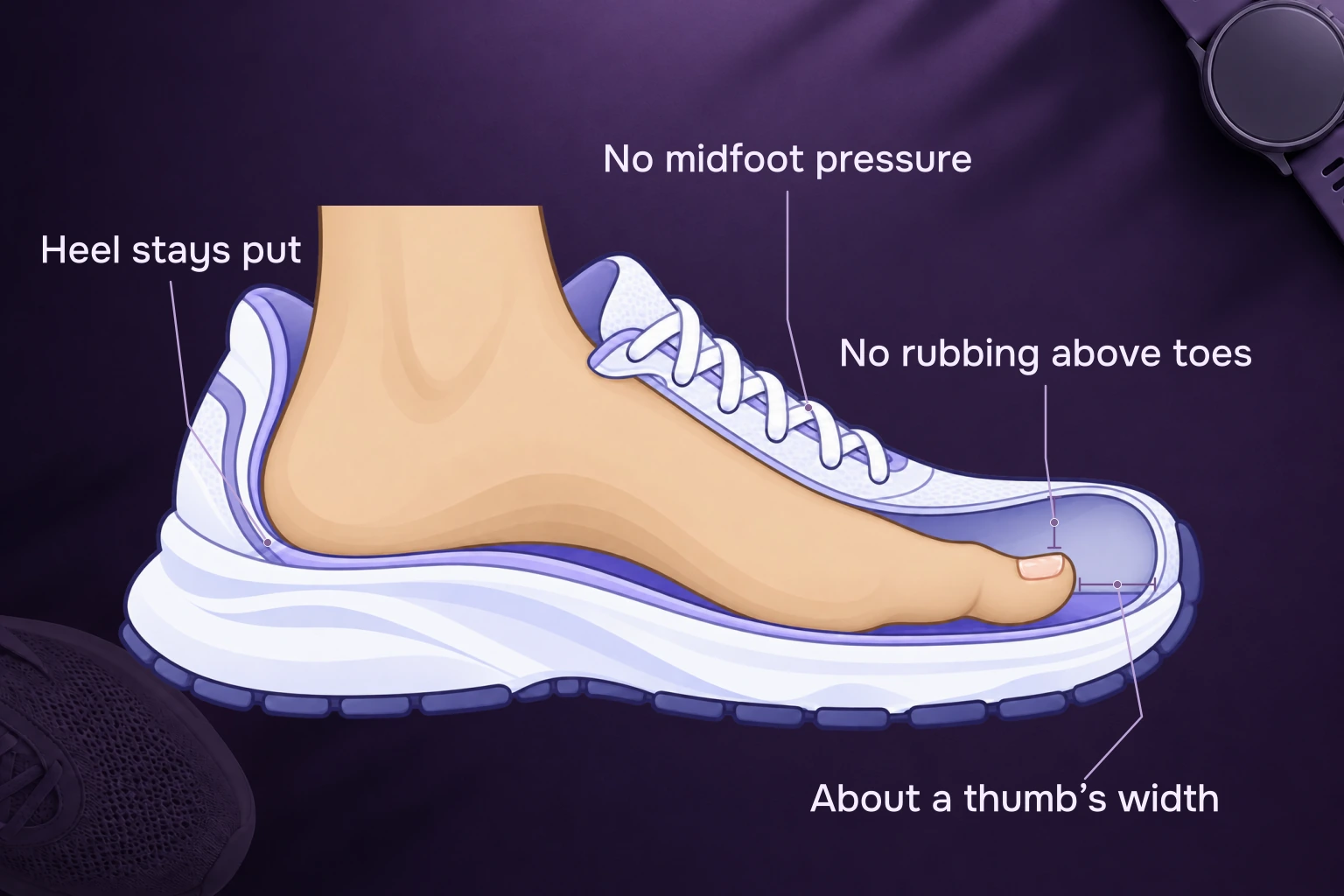
Each check exists because a specific failure is common. Too little toe room ends in black toenails and sore toes on downhills; a slipping heel rubs into blisters; midfoot pressure turns to numbness a mile in; and a shallow toe box presses the tops of the toes into calluses. If your current shoes produce any of these, name the check and take it to the store.
Any check that fails in the store will fail louder after a mile. A shoe that pinches at purchase does not break in; it breaks you in.
When and How to Measure
Try shoes on at the end of the day, when your feet are at their largest, and fit the pair to your larger foot.[1] Have your feet measured rather than trusting memory: foot size and shape change over time.
Treat the printed size as a starting point only. Sizing differs by brand and even by model, and no shoe stretches into a fit it lacks. Half a size is often the whole difference between a pinch and a fit, so compare the half size up whenever a shoe feels close but not right.[5]
Width, Shape, and Size Systems
Look at the shape of the shoe next to the shape of your foot: the shoe should resemble your foot, and the widest part of your foot should sit in the widest part of the shoe.[1] Toe boxes vary by model, some pointed for speed, others rounded for room. If your toes crowd, try the next width or a roomier model before sizing up past a thumb's width.
Widths use letters. In U.S. running shoes, a D width is the men's standard and a B is the women's standard, with wide and extra-wide steps above each. The letters are a general convention, and brands interpret them differently, so treat the table as a map, not a guarantee; the four checks still decide.
| Width | Men's letter | Women's letter | Fits |
|---|---|---|---|
| Narrow | B | 2A | Narrow feet |
| Standard | D | B | Most feet; the default most brands build |
| Wide | 2E | D | Roomier across the ball of the foot |
| Extra wide | 4E | 2E | Wide feet that crowd a standard shoe |
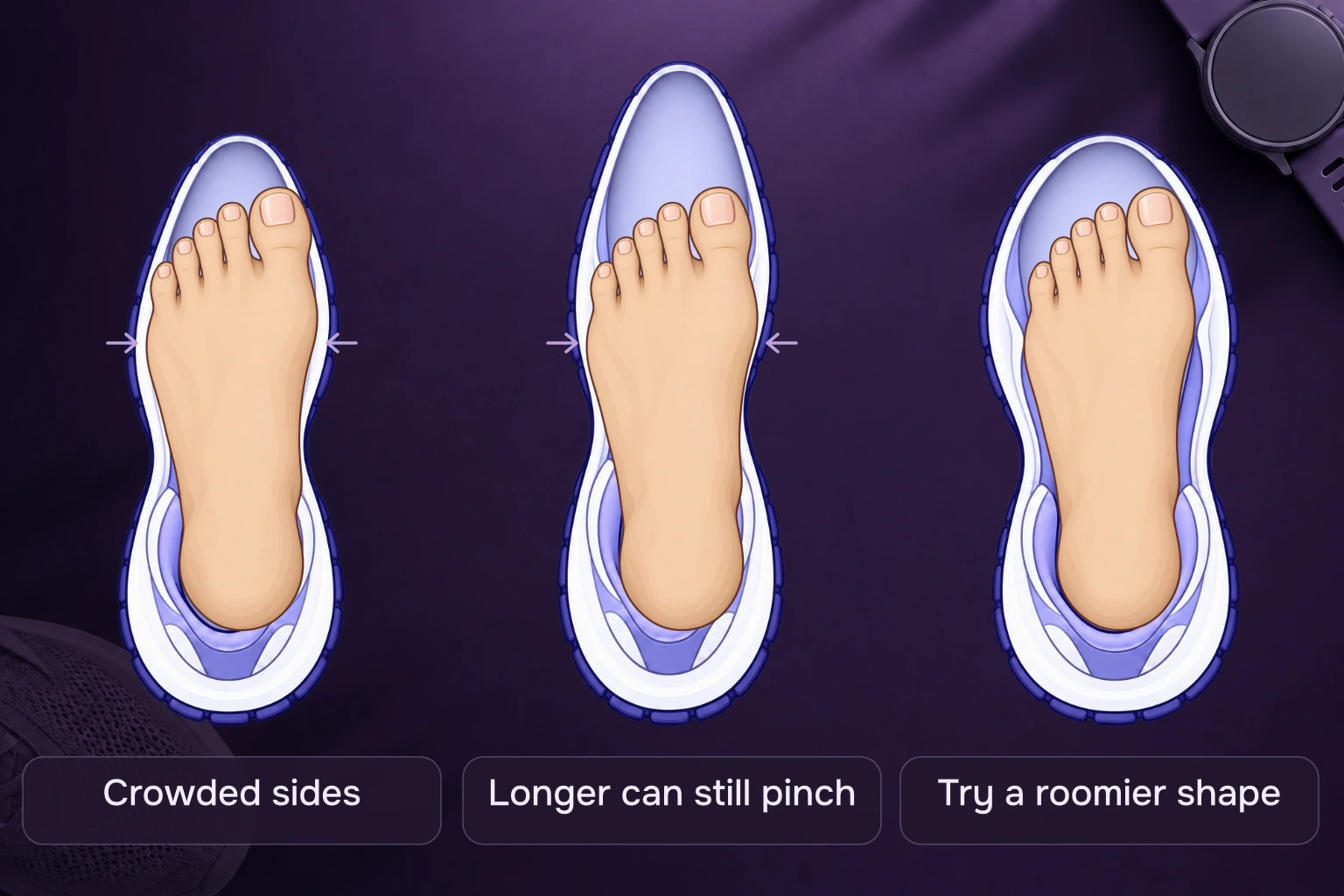
Many everyday trainers come in wide versions, so width is a fit problem with a fit solution, not a reason to live with pressure. If a standard width crowds your toes, ask for the wide version of the same model before switching brands.
Size systems also differ: a men's U.S. size and a women's U.S. size sit about 1.5 sizes apart, and European and U.K. numbers use their own scales. None of that matters for the decision. What matters is that you find your size in each brand by feel, with the four checks, not by the number printed on the tongue.
Fit Details Most People Miss
A few small details change how a shoe fits on the road.
- Lacing: when a heel slips, the fix is often the laces, not the size. Thread the lace back through the extra top eyelet on each side to make a loop, cross the laces through the loops, and pull down: this heel lock pulls the heel into the back of the shoe and stops the slip.
- Sock weight: a shoe fitted in thin socks fits differently in winter socks. Fit the shoe in the socks you will actually run in, and give winter pairs their own try-on.
- Insoles: shoes come with a factory insole, and replacing it with a better off-the-shelf insole can improve a near-right fit. An insole you add should still leave the toe room and heel hold intact.
- Hot spots: any point that feels warm after the store jog will rub raw after a real mile. Relace, try the next width, or move to another model before accepting it.
If a shoe passes the four checks but still feels off, check these details before you check out.
The Try-On
Wear the socks you actually run in and try both shoes, not just one. Lace them normally, stand, walk, and then jog a few steps when the store allows it. Twenty steps in a shoe answer more than twenty minutes of reading about it.
A pair that fits feels comfortable right away, more like a firm handshake than a squeeze, and there is no break-in period that fixes a pinch: if it hurts in the store, it will hurt on the road.[2]
Compare at least two pairs side by side, because fit is a comparison, not an absolute. In each one, check three feelings at the jog.
- No heel slip: the back of the shoe moves with your heel, not against it.
- No toe bang: your toes never reach the front, even in the first push-off steps.
- No hot spot: nothing rubs where the upper meets the foot.
When the store has a treadmill or lets you jog a few steps, take the chance: a minute of easy jogging is worth more than an hour of standing in front of the mirror.
Buy somewhere with a return policy that covers a short indoor test run, and keep the first outings short while you confirm. Ordering online is fine once you know your size and shape in a model; the first pair of any model deserves a store try-on or a generous return policy. If you must order the first pair blind, order your usual size and the half size up, and return the one that fails the four checks.
A specialty running store adds one honest service: someone who watches you move in a few pairs and shortens the shortlist. Use the help if it is available, and keep the decision yours.
And it is allowed to walk out with nothing. A shoe that fails the checks in the store saves you nothing by coming home. No pair is the correct answer when every pair pinches; the next store or the next week usually holds the fit.
Match the Shoe to How You Run
After fit, the second question is what the shoe will do. The answer starts with the surface, then the categories the store will show you.
Road Versus Trail
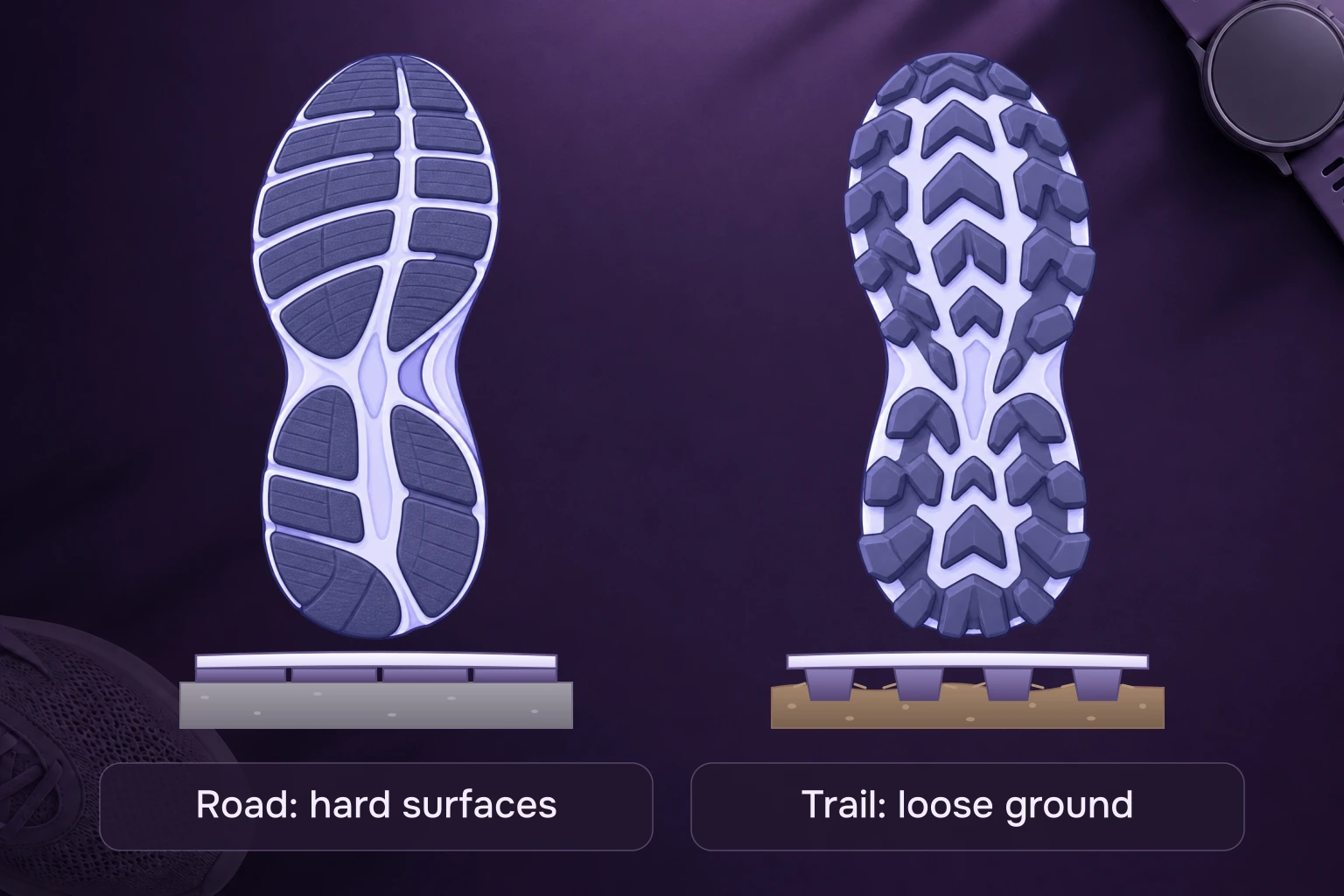
Road shoes have a smooth outsole and a light build, which suits pavement, sidewalks, and treadmills. Trail shoes add aggressive tread and often a rock plate for dirt, gravel, and roots.[2][4] Both are compromises: trail lugs wear quickly on pavement, and smooth road soles slip on mud. Buy for the surface you run most, not the surface you imagine.
Wet pavement does not require trail shoes; road tread grips wet asphalt well enough for ordinary running. Trail shoes earn their place only when you actually run trails. Most beginners can postpone the trail question entirely: the road pair covers the first season, and the trail pair joins when trails actually appear.
| Feature | Road shoe | Trail shoe |
|---|---|---|
| Outsole | Smooth, light rubber | Deep lugs for loose and uneven ground |
| Protection | Minimal; built for even pavement | Often a rock plate under the forefoot |
| Feel | Lighter and quicker on hard surfaces | Grippier and heavier on hard surfaces |
| Best on | Pavement, sidewalks, treadmills | Dirt, gravel, roots, mud, snow |
One exception is worth naming: packed winter snow and ice. A trail shoe's deeper lugs help on packed snow, but no running shoe solves ice; that is a traction device question, and it belongs to a winter outing's plan, not to the shoe shelf.
The Everyday Trainer and Everything Else
For most new runners, a neutral everyday road trainer is the whole decision. The other categories exist for specific jobs, and none of them is a beginner requirement.
- Racing and plated shoes are built for speed on race day, cost more, and wear faster. They are not the daily shoe.
- Lightweight tempo shoes trade cushion for snap. Nice later, not needed now.
- Waterproof versions keep slush out and can feel warmer because they reduce airflow, although they are not necessarily insulated. They only earn their place when snow and standing water are regular; the waterproof and winter section below covers them.
One category line matters in the store: walking shoes and running shoes flex differently. Running shoes cushion the heel and flex at the toes for running's repeated landing, while a walking shoe flexes at the ball.[1] If you will mostly walk with short running stretches, either can work, but buy the shoe for the main activity.
One sizing line matters too: men's and women's versions are built on different lasts, with the women's shoe typically narrower through the heel and the men's wider overall. The letters are a starting point, not a rule: runners with wide or narrow feet sometimes fit the "other" version better. If a brand runs wrong for your foot, try the other version in a nearby size before giving up on the model.
Neutral Versus Stability
Shoe walls speak in categories like stability, motion control, and pronation. In plain terms: every foot rolls inward a little when it lands, and that inward roll is pronation. Stability shoes add firmer material on the inside edge to slow a pronounced roll; neutral shoes do not. Whether you need that firmer edge is where the marketing and the research part ways.
A 2015 review in the British Journal of Sports Medicine proposed a comfort filter, the idea that the shoe that feels most comfortable is a defensible choice, instead of matching a category to a measured foot shape.[3] The review argues that the evidence for prescribing shoes by foot type is weak, and that a comfortable shoe is a reasonable way to choose while that evidence stays thin.
Some runners genuinely prefer stability features, and a specialty store can watch you move and suggest styles to compare. Treat that as help with the shortlist, not a required exam, and treat a store's foot-scan machine the same way: it measures, but no measurement replaces how the shoe feels at a jog. When two shoes both pass the fit checks, buy the one that feels better.
Cushioning and Heel Drop
Cushioning is a preference, not a grade. More is not automatically better: foam amount, firmness, and shoe weight are separate properties. More foam does not automatically mean a softer or heavier shoe, and firmer shoes generally give more ground feel.[4] For an easy regular run, the honest choice is the cushioning that feels good at a jog, not the biggest number on the wall.
| Cushion feel | What it is like | Typical for |
|---|---|---|
| Firm and responsive | You feel the ground and get a quicker push-off | Experienced runners and faster days |
| Moderate | An everyday blend of feel and softness | Most daily trainers |
| Soft | Plush landings with less ground feel | Easy miles and walkers |
Heel-to-toe drop is the height difference between the heel and the forefoot, usually 0 to 12 millimeters. A higher drop suits heel-first landings; a lower drop encourages a more midfoot landing. The ranges below are stated in the manufacturers' own product specifications. Specification-based.
| Drop | Range | Feels like |
|---|---|---|
| Low | About 0 to 4 mm | Closer to barefoot; more calf and foot work |
| Mid | About 5 to 8 mm | The everyday middle most trainers use |
| High | About 9 to 12 mm | The heel sits higher relative to the forefoot |
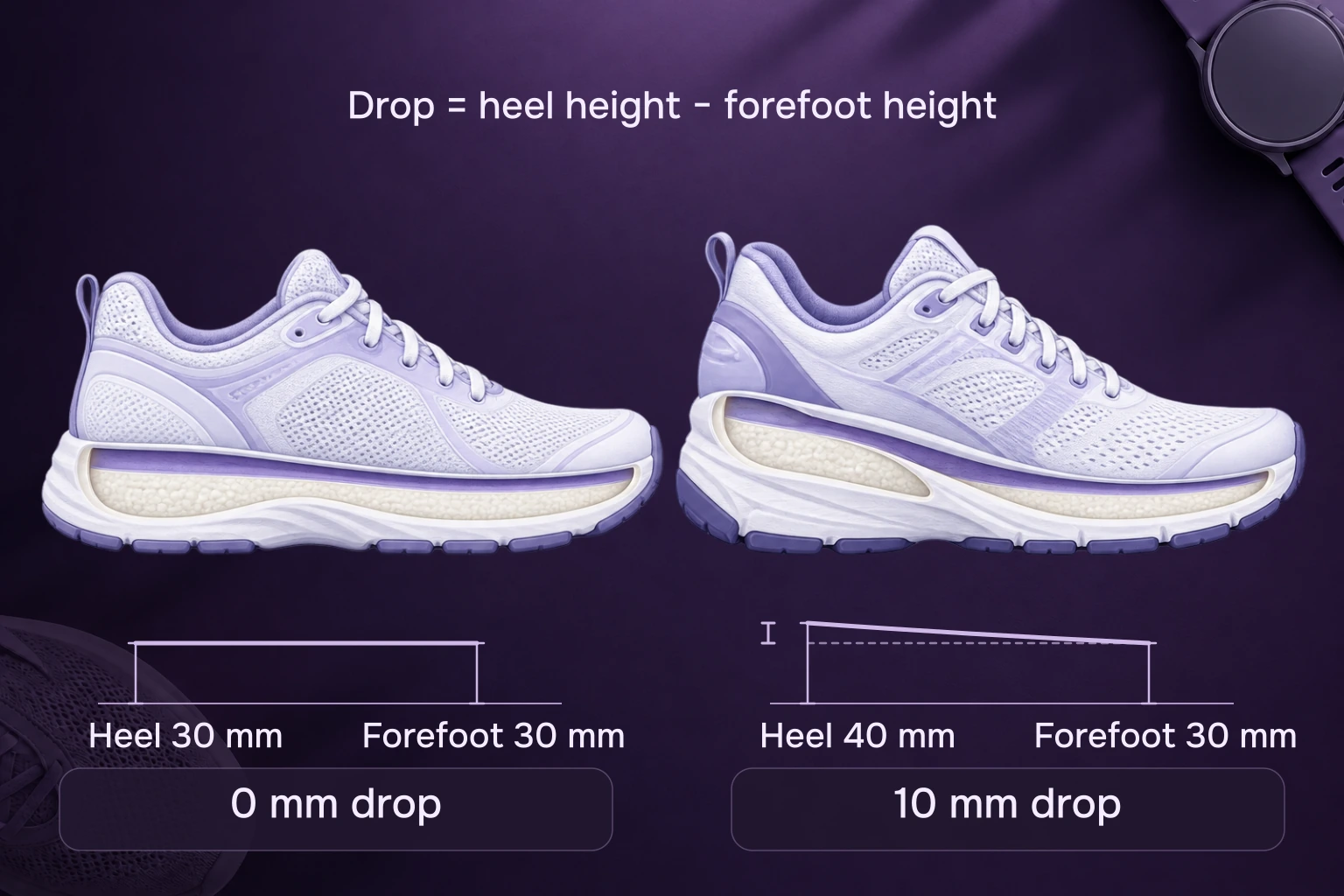
None of this matters for your first pair. What matters is that you change gradually: switching drop levels abruptly can strain the Achilles tendon and calves.[2] When a new pair lands far from your old pair's drop, alternate them for the first weeks instead of switching all at once.
Typical Picks at Three Budget Tiers
The models below are examples to calibrate against, not recommendations. Fit is individual, so the tables show what each tier typically looks like; the choosing happens on your foot, with the checks above.
Road Daily Trainers
Typical neutral road trainers at each tier, listing-checked in October 2026. Each model comes in men's and women's versions, and a well-fitting equivalent does the same job. Independently researched.
| Tier | Men's typical pick | Women's typical pick | What they are |
|---|---|---|---|
| Affordable | New Balance Fresh Foam 680 v9 | ASICS GEL-CONTEND 9 | Budget neutral daily trainers |
| Mid-tier | Brooks Ghost 17 | ASICS GEL-CUMULUS 27 | Workhorse neutral daily trainers |
| Premium | Brooks Glycerin 23 | ASICS GEL-NIMBUS 28 | Max-cushioned neutral trainers |
Trail Shoes
Trail shoes earn their place when dirt, gravel, and roots are the usual surface. Look for lugs deep enough for your trails, a rock plate for sharp ground, and an upper that drains and dries. Typical picks at each tier, listing-checked in October 2026; men's and women's versions exist for each. Independently researched.
| Tier | Men's typical pick | Women's typical pick | What they are |
|---|---|---|---|
| Affordable | ASICS GEL-VENTURE 9 | ASICS GEL-VENTURE 9 | Budget trail shoe with dependable lugs |
| Mid-tier | Brooks Cascadia 18 | Brooks Cascadia 18 | Workhorse trail shoe with a rock plate |
| Premium | HOKA Speedgoat 6 | HOKA Speedgoat 6 | Max-cushioned trail shoe for rough ground |
How to Read the Tables
A model in a table is a starting point, not a destination. Models change version, leave the market, or simply fit your foot wrong. The criteria in the sections above stay; the names are how you find examples. When a listed model is unavailable, any shoe that passes the fit checks and matches your surface does the same job.
What the tiers actually buy is refinement, not correctness: budget trainers use dependable foam and mesh, mid-tier trainers refine the ride and the upper, and premium trainers add lighter materials and softer foams. A well-fitting affordable shoe is a complete answer; a premium shoe that pinches is a mistake at any price. Independently researched.
| Tier | Typical midsole | Typical upper | Honest tradeoff |
|---|---|---|---|
| Affordable | Dependable basic foam | Mesh with basic overlays | Everything you need; less polish and fewer refinements |
| Mid-tier | Refined, more durable foam | Engineered mesh and better lockdown | The workhorse balance most runners settle into |
| Premium | Softer, often lighter foams | Lighter, more comfortable materials | Refinement you may or may not feel; not a better decision |
Waterproof and Winter
Winter rarely asks for a new shoe; it asks for the right surface answer. Before buying anything, run your current pair through three questions.
Keep, Supplement, or Buy
- What repeats underfoot. Judge by the surfaces on your regular route, not by the worst winter day: cleared asphalt, packed snow, loose snow, slush, or smooth ice. A once-a-season ice patch and two hundred daily yards of it are different problems.
- Where the water goes. If your socks are soaked by mid-run in slush every time, the upper is not doing its job. Water enters through the mesh, the seams, the tongue, or over the collar; the fix depends on which one.
- What the pair can still do. A tread worn smooth, a flattened midsole, or a torn upper will not improve in winter.
All three pass: keep the pair. One fails and a small add-on closes it: supplement. The failure needs a mechanism the pair does not have, such as studs for ice or a membrane for standing slush: buy. And no, a drop in temperature alone does not create a winter shoe purchase.
What Waterproof Actually Means
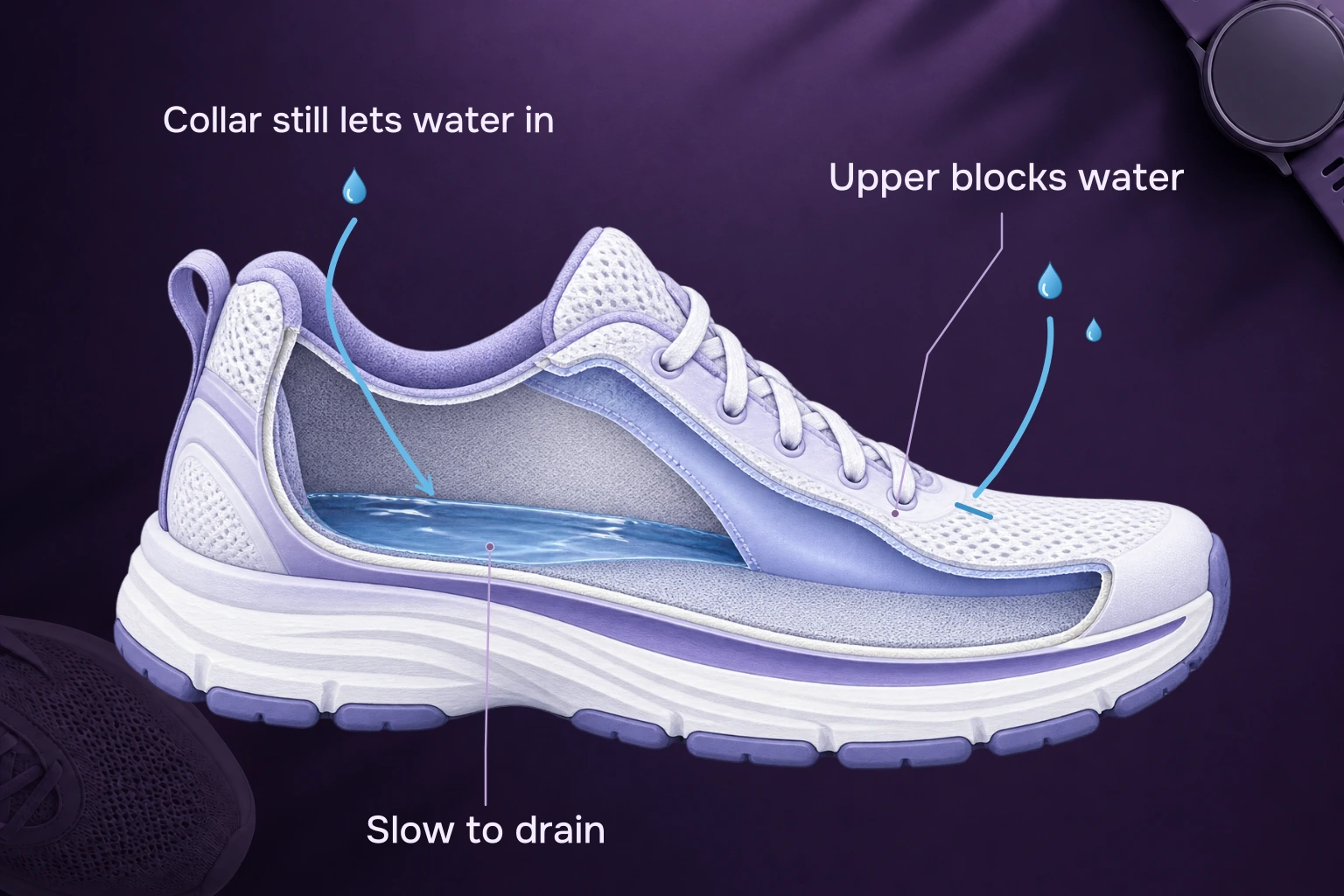
There is no technical standard behind the word "winter" on a shoe box, and waterproof is narrower than it sounds. A membrane such as GORE-TEX keeps liquid water out of the covered part of the upper. Waterproof construction does not necessarily include insulation, but reduced airflow can make the shoe feel warmer.[6] It does not improve grip, and it keeps in whatever water enters over the collar, so the shoe drains poorly. Specification-based.
Around the membrane sit the details that decide whether it helps: a water-repellent coating on the upper, a tongue stitched high to the sides, and a gaiter that closes the ankle gap against snow. In rain, your feet get wet either way and quick-drying socks recover faster; membranes earn their place in slush, standing water, and wet snow, not in drizzle.
The membrane version of a model is a different shoe from the plain version: it fits a little differently, breathes less, and costs more. Judge it on your foot, with the same checks, not by the word on the box.
Asphalt, Snow, and Ice
Winter grip is three separate mechanisms for three separate surfaces, and none of them converts into another.
| Surface | What works | Honest limit |
|---|---|---|
| Cleared asphalt, wet or dry | A regular outsole; grip differs almost twofold between models that look identical | The "winter" label says nothing about grip |
| Loose snow | Deep, widely spaced rubber lugs bite into the soft surface | The same lugs wear fast on pavement |
| Packed snow | Lugs still work until the snow is polished to a shine | Polished packed snow behaves like ice |
| Smooth ice | Metal: factory studs or removable traction devices | Studs reduce slips, they do not end them |
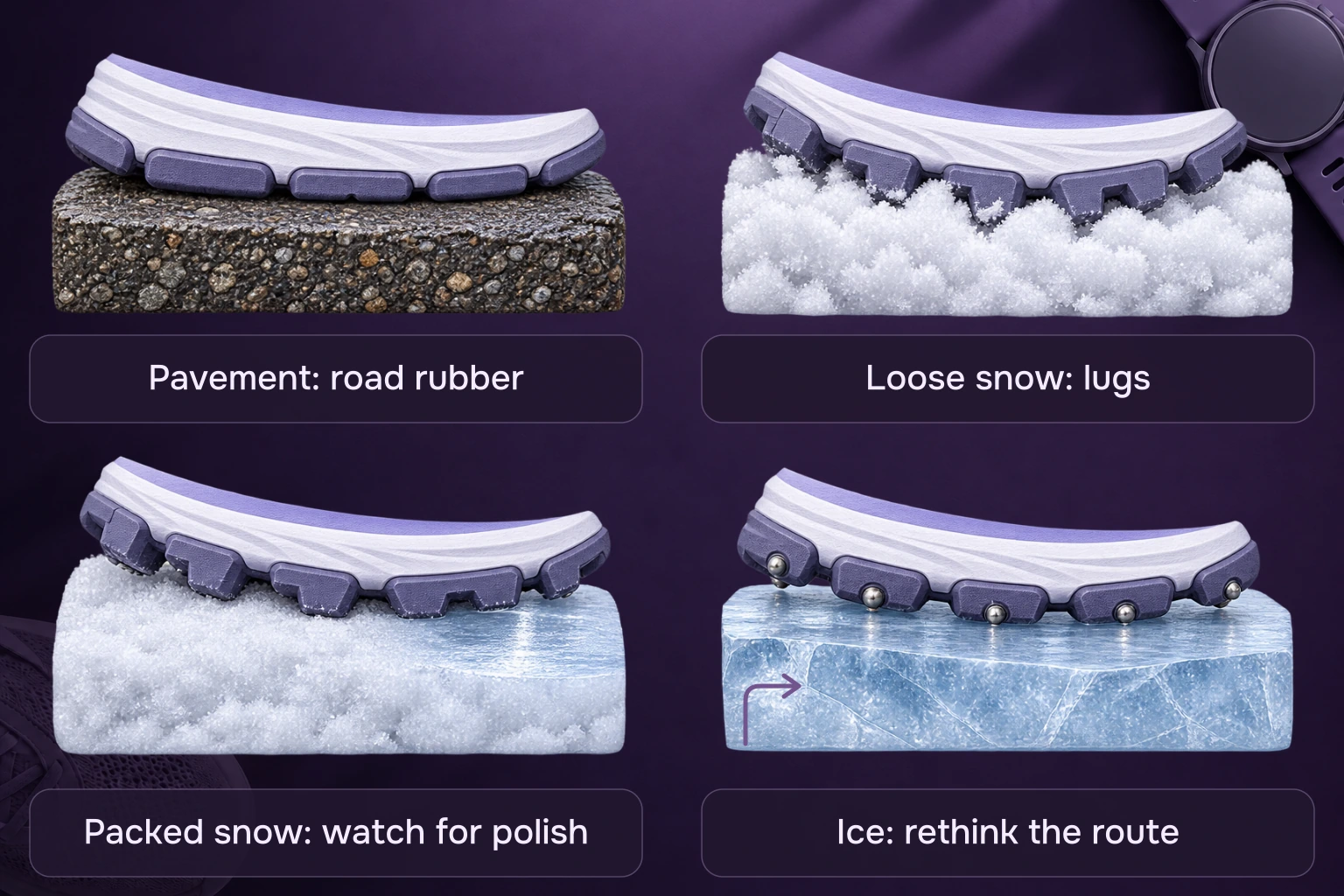
For ice, the honest logic is route-first: if the ice is a short stretch you can walk or detour, you do not need metal on your feet. If smooth ice is a regular, unavoidable part of every winter run, studded shoes or removable traction are the only mechanisms that work, and even they change the odds rather than remove the physics. A fully iced route is a route question, not a shoe question.
Typical Waterproof and Winter Picks
Listing-checked in October 2026. Waterproof membranes rarely reach the affordable tier, so at that price quick-drying socks and a route change do more work than a cheap membrane. Independently researched.
| Typical pick | What it is | Honest limit |
|---|---|---|
| Brooks Ghost 17 GTX | Waterproof road daily trainer | The membrane keeps slush out and can feel warmer with less airflow, but does not necessarily add insulation; the GTX version fits slightly differently from the plain Ghost |
| Nike Pegasus Trail 5 GORE-TEX | Waterproof road-to-trail for slush and light snow | Trail tread is extra weight on pure asphalt |
| Salomon Speedcross 6 GORE-TEX | Waterproof trail with 5 mm lugs for soft snow | Narrow fit; aggressive for long pavement |
| HOKA Speedgoat 6 GTX | Max-cushion waterproof trail for long snowy routes | Slow to dry once water gets in |
For regular ice, the specialist options are narrow: the Icebug Arcus 2 BUGrip GTX and Salomon Winter Cross Spike are running shoes with factory metal studs, and the Yaktrax Run is a removable traction device that straps over your own pair. All three reduce slips on ice; none of them is comfortable or durable on long dry asphalt, and the removable device only helps if you actually stop to put it on. Independently researched.
None of this changes the earlier decision order: fit first, then surface. A waterproof shoe that pinches is still a wrong shoe, and no stud solves a route you could walk around.
Winter Myths Worth Forgetting
- "Winter" on the box means winter. There is no standard behind the label; properties are checked one by one, not by the word.
- A membrane means warm and dry. It does not necessarily mean insulation; reduced airflow can make the shoe feel warmer, and water entering over the top can remain trapped.
- Deep tread holds on ice. Lugs work on soft surfaces; smooth ice needs metal.
- Size up half a size for winter. Fit in the sock you will actually run in. A thick sock that squeezes the foot is a fit problem, not insulation.
Buy Now, Plan Next
Buy what this season's running needs now, and treat the next step as a plan. The first pair is the main purchase; everything after it should answer a need you have actually met.
| Buy now | Plan for next | You probably already own |
|---|---|---|
| One pair that fits this season's surface | A second pair to rotate once runs are regular, or a trail pair if trails appear | Comfortable sneakers for the first short outings |
The buy-now column is this month's decision. The plan-for-next column is a watchlist, not an order: note it now, and buy when the need actually appears. If your region's weather or your route changes, promote the plan to a purchase then.
Concrete triggers for the next purchase, in the order they usually appear:
- The midsole goes flat or the outsole wears unevenly: retire and replace.
- Runs become regular, three or more a week: a second pair for rotation.
- The surface changes, such as a move from pavement to park trails: the matching shoe.
- Winter arrives with slush and packed snow: consider a waterproof or lugged option for those outings.
Socks finish what the shoe starts: quick-drying, season-weight pairs keep the fit working, and the running essentials guide covers them in depth.
Rotation and Replacement
A second pair is not a luxury once you run a few times a week. Rotating two pairs lets each one's cushioning rebound between runs and makes a worn-out pair obvious sooner. Buy the second pair after the first one proves itself, not before.
Most running shoes last about 300 to 500 miles, depending on your weight, the terrain, and your stride.[2] A flattened midsole that no longer springs back or an uneven outsole can prompt a closer inspection. New aches during familiar runs are also a reason to inspect the pair and consider other causes, including changes in training.
| Sign | What it tells you |
|---|---|
| Flattened midsole that no longer springs back | The cushioning has done its miles |
| Uneven outsole wear | The support is going uneven, or the fit was never quite right |
| New aches during familiar runs | Inspect the pair and consider other causes, such as changes in training; seek advice if pain persists |
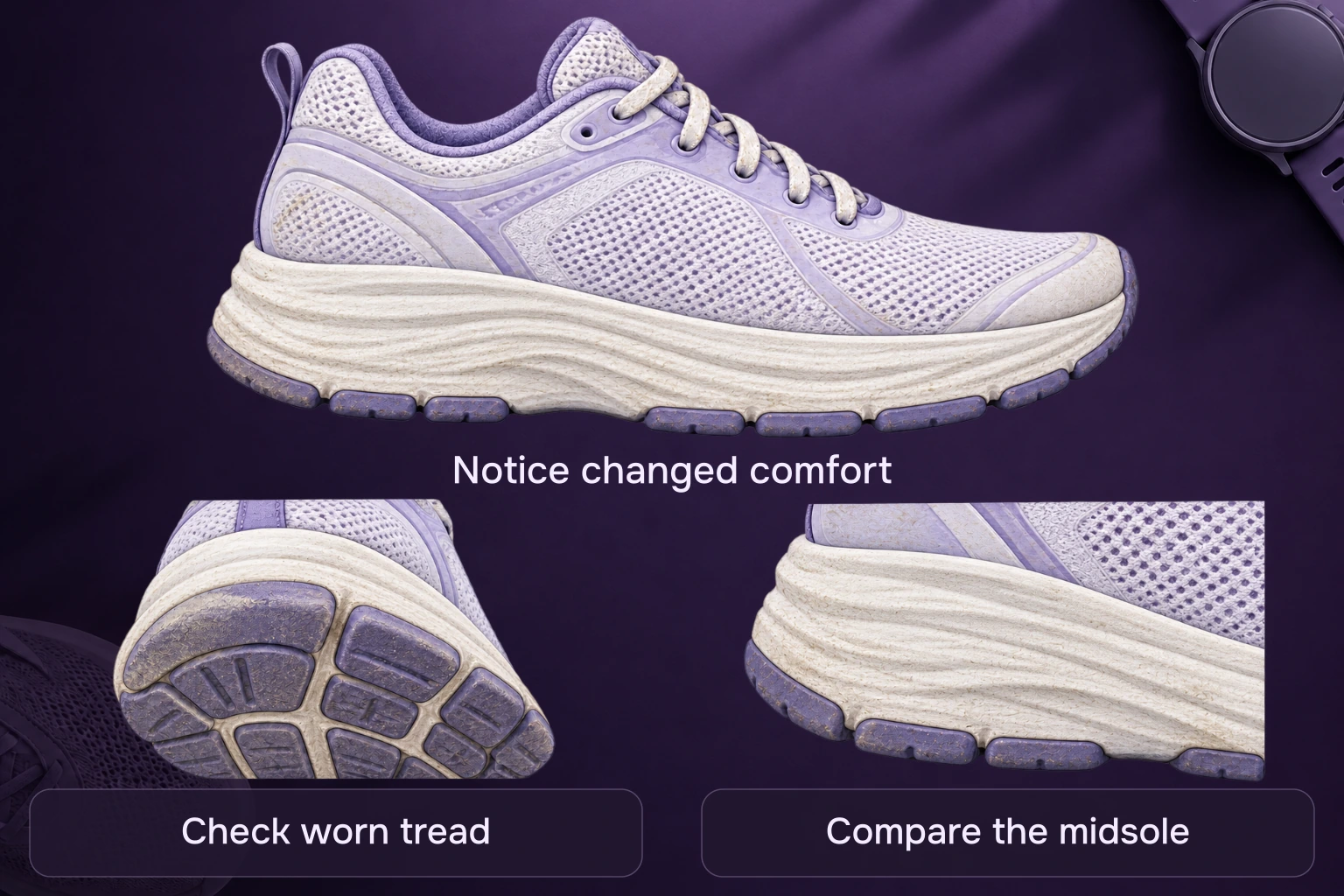
Note the date you start running in a pair, and check the signs around 300 miles. You do not need a running watch to track this: a rough weekly estimate is enough, because the signs above matter more than the number. A worn shoe still looks like a shoe; it just stops protecting you.
The second pair can be the same model or a different one. The same model removes all decisions and lets you compare wear directly; a different model adds variety and a spare style for different outings. Either is fine, and neither is a reason to delay the first pair.
Between runs, let shoes dry fully instead of leaving them crumpled in a bag: moisture breaks down the midsole and the glue faster than miles do. The 300- to 500-mile range already assumes ordinary use; soaked shoes left wet will end on the short side of it.
When a pair retires from running, it can often finish its life as a walking shoe if it still feels comfortable. That is a retirement, not a rescue: once the midsole goes flat, the shoe is done as a running shoe.
The Complete Decision in Order
Put the whole guide on one card, in the order it happens in the store.
- Name the surface. Road, sidewalk, and treadmill point to a road shoe; real trails point to a trail shoe.
- Measure both feet at the end of the day, and fit to the larger foot.
- Run the four checks in the candidate shoe: toe room, heel hold, midfoot, depth.
- Jog a few steps in two or three pairs in your running socks.
- Pick a tier. Any tier is a complete answer; the fit checks decide, not the price.
- Buy with a return option that covers a short indoor test.
- Note the start date and check the replacement signs around 300 miles.
Every step except the last happens with the shoe on your foot. That is the point: the store is where the decision lives, and the reading only prepares you for it.
Three classic mistakes sit beside that order, worth naming because the store invites all three.
- Buying the popular model because reviews love it, then discovering it loves someone else's foot. Reviews measure the shoe; only your foot measures the fit.
- Buying for the imagined run, the trail pair or the race pair that never happens, while the actual weekday route goes unshod.
- Keeping a pair too long because it still looks like a shoe. The midsole fails before the upper, and the upper is what you can see.
What Shoes Cannot Fix
Shoes are gear, not medicine. They remove discomfort, not causes: persistent, worsening, or sharp pain, numbness, or a blister problem that survives good fit belongs to a clinician, not to another pair of shoes. RunOutNow does not diagnose or treat.
What a shoe can do when something hurts is limited: a different fit can remove a specific rub, but new aches are not proof that the midsole is worn out. What it cannot do is cure a problem that began somewhere else. When pain repeats on familiar runs, the next step is rest and a clinician, not a more expensive model.
And no shoe guarantees staying injury-free. The comfort filter is a sensible way to choose, not a promise; the research proposes comfort as a guide precisely because the old categories could not predict injury reliably.[3] Buy the shoe that fits and feels right, run in it, and let your own feedback decide what comes next.
Common Questions
How should running shoes fit?
Leave about a thumb's width of room beyond your longest toe, keep your heel snug without slipping, and feel no pressure across the midfoot. The shoe should feel comfortable the first time you jog in it.
Do I need a stability shoe or a gait analysis?
Not necessarily. Research suggests comfort is a reasonable guide, and a specialty store assessment is optional help rather than a required test. If a shoe feels good, holds your heel, and gives your toes room, it is a fine place to start.
How often should I replace running shoes?
Most pairs last about 300 to 500 miles. Inspect the pair sooner if the midsole feels flat, the outsole wears unevenly, or familiar runs bring new aches. Consider other causes of new pain and seek advice if it persists.
Can I start running in my everyday sneakers?
Yes. Comfortable shoes you already own are fine for early short outings. Buy running shoes once you run regularly or your current shoes stop feeling good.
Are expensive running shoes better?
Not automatically. Fit and comfort matter more than price, and the tables above show affordable picks doing the same job as premium ones. Each judgment is labeled with how it was made.
How do I order the right size online?
Treat the printed size as a starting point: sizes differ by brand, so check the maker's size chart and fit by feel. The first pair of any model deserves a store try-on or a return policy that covers a short indoor test.
Do I need separate road and trail shoes?
Only if you run trails. Road shoes cover pavement, sidewalks, and treadmills; trail lugs wear quickly on pavement. Buy the trail pair when trails actually appear.
What if my feet are two different sizes?
That is normal: most people have one foot larger than the other. Fit the pair to the larger foot, and use lacing or a thin insole to settle the smaller one.
Should I buy a size up for swelling?
No. Try shoes on at the end of the day, when your feet are at their largest, and the fit you get then already accounts for daily swelling. Sizing up on top of that leaves too much room, and the heel starts to slip.
What shoe should I wear on a treadmill?
A road shoe: a smooth outsole and a light build suit treadmill belts the same way they suit pavement. Trail lugs are wasted indoors and wear unevenly against the belt.
Are running shoes unisex?
Not exactly. Men's and women's versions are built on different lasts, with the women's shoe typically narrower through the heel. If a brand fits your foot wrong in one version, trying the other version in a nearby size sometimes fixes it.
Do I need waterproof running shoes for winter?
Only when slush, standing water, or wet snow are regular on your route. In rain your feet get wet either way. Waterproof construction does not necessarily include insulation, but reduced airflow can make the shoe feel warmer. See the waterproof and winter section above.
Should new running shoes feel tight at first?
No. A pair that fits feels comfortable right away, like a firm handshake, and a pinch in the store will not improve on the road.
You will know you chose well when the shoe stops being a thing you think about: no pinching by the first mile, no heel slip on the way back, and no surprise aches the next morning. That is what the fit checks buy. The decision stays yours, and the shoe stops being the reason you hesitate.
Your next step: Name your surface, then try two or three pairs in your running socks at the end of the day, jog a few steps in each, and take home the one that fits best. Note the date you start running in the pair.